This article explores the current state of GenAI adoption within agencies and marketing teams in 2026. It highlights where organizations truly stand today and identifies the critical steps needed to move beyond early wins toward genuine AI maturity.
Key insights include:
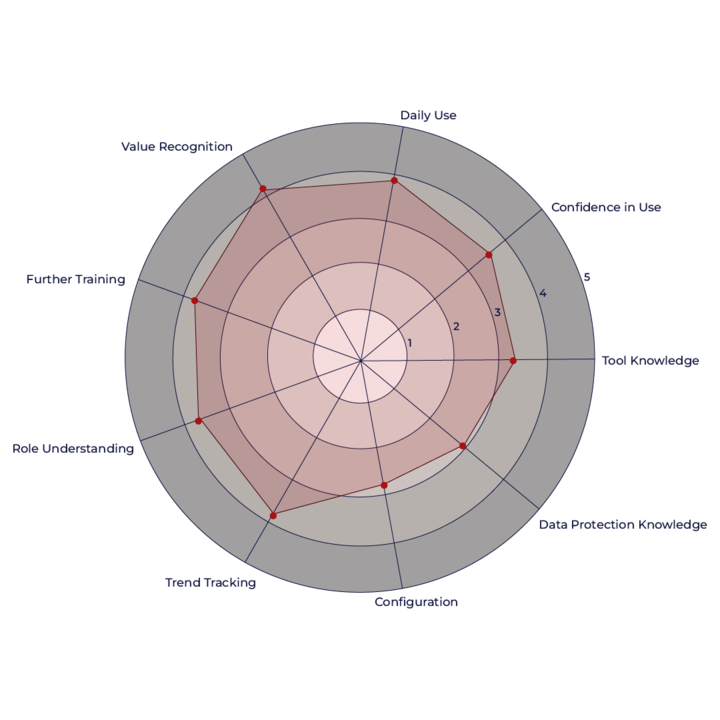
- Perceived Value vs. Practical Readiness: Why AI’s value is widely acknowledged at an impressive 4.26 points, while hands-on implementation capabilities still lag.
- The Technical Configuration Gap: The significance of the technical configuration gap, scoring just 2.74 points, and how organizations can address it.
- Agencies vs. In-House Marketing Teams: How agencies, with their creative and efficiency-driven focus, differ from marketing teams, which prioritize strategy and data.
- AI Personality Types in Teams: An overview of four distinct AI personality types—Driver, Navigator, Pioneer, and Explorer— and how teams can intentionally develop them.
Executive Overview: Key Insights at a Glance
Our analysis presents a nuanced view of AI adoption across the creative and marketing landscape. Although the added value of AI tools is strongly recognized, averaging 4.26 out of 5, there remains a clear disconnect between perceived potential and real-world execution. Most notably, technical configuration skills score only 2.74 points, emerging as a major limitation to effective AI utilization.
51% of participants work in agencies, while 49% are in marketing teams.
52% identify as “Drivers,” actively pushing AI initiatives forward.
The most pronounced skills deficit lies in configuring AI tools.
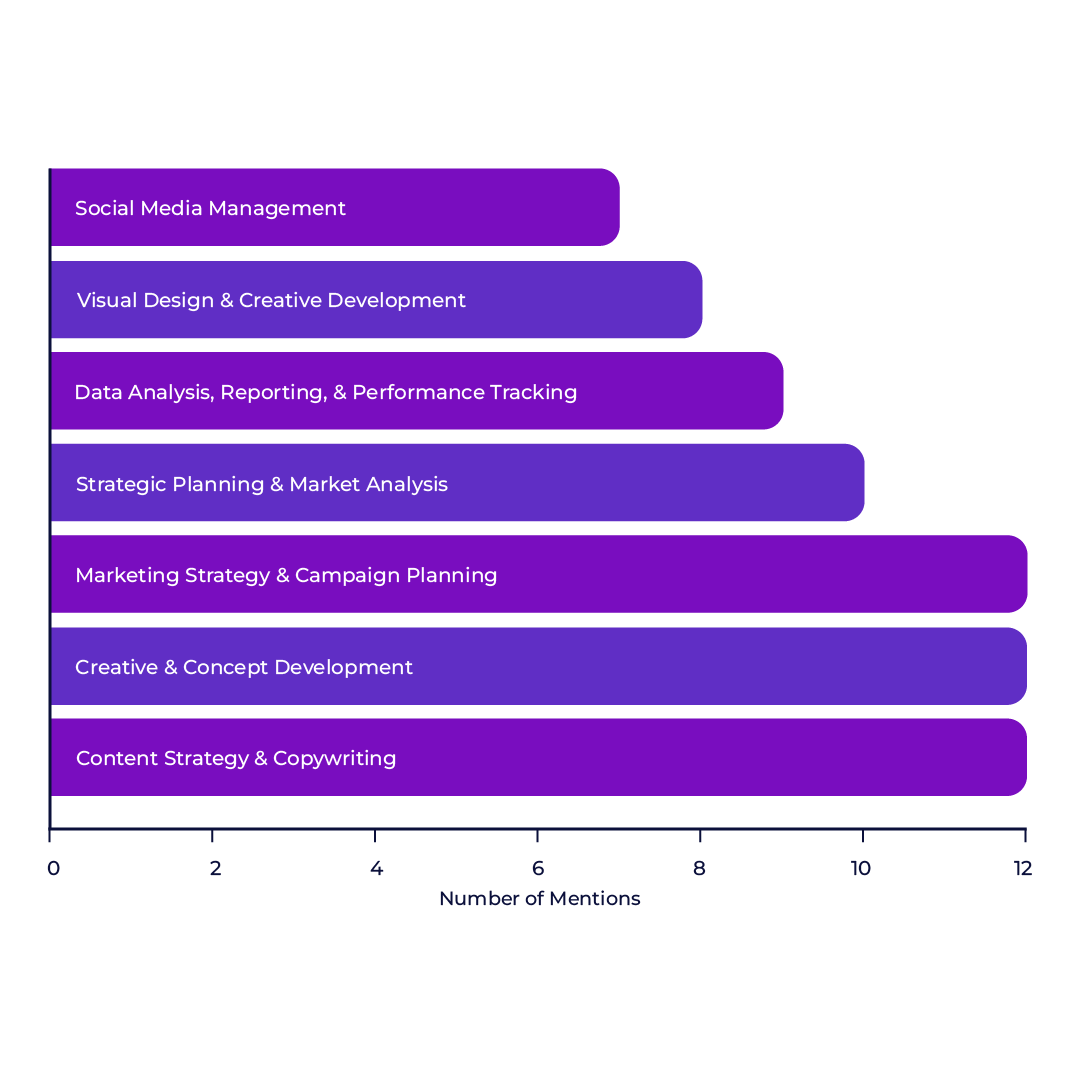
Content strategy currently leads AI use cases.
Methodology and Participant Profile
This analysis is based on insights gathered from 92 professionals working across agencies and marketing teams between April and June 2025. The respondent base is almost evenly divided, with 51% representing agencies and 49% coming from in-house marketing departments.
Among agency participants, leadership roles are strongly represented, with 40% holding management or executive positions. This concentration is even more pronounced within marketing teams, where 80% of respondents identify as marketing managers or CMOs.
The AI Competence Radar: Strengths and Gaps
Participants evaluated nine core dimensions of AI usage. The results reveal strong enthusiasm paired with a clear technical skills deficit.
Leading Areas
Value Recognition (4.26) and Daily Usage (3.93) indicate AI is already embedded in everyday workflows.
Areas Needing Attention
Technical Configuration (2.74) and Compliance (2.92) present significant risks to effective scaling.
AI Use Cases: Where Change Is Happening
Content strategy and copywriting dominate, followed by creative concept development and strategic planning.
● Content Leadership
Generative AI is reshaping content production; tasks that once took hours can now produce drafts in minutes.
● Redefining Creativity
AI increasingly serves as a creative partner, supporting ideation, brainstorming, and concept development.
● Strategic Momentum
AI is becoming a strategic asset, reinforced by rising importance of data analysis and performance tracking.
Agencies vs. Marketing Teams: Different Focus, Shared Direction
Agencies
Agencies primarily leverage AI for creative outputs such as content creation, conceptual work, and visual design.
- Streamlining internal operations
- Automated time tracking
- Smarter resource allocation
Marketing Teams
Marketing teams tend to prioritize data-driven applications, including analytics, performance measurement, and strategy.
- Scaling complex campaigns
- Personalized marketing efforts
- Performance-based decision making
The Four AI Personality Types
Pragmatic and outcome-focused, this group concentrates on concrete use cases and measurable results.
Strategic thinkers who see AI as a long-term transformation lever, often shaping AI roadmaps.
Early adopters who experiment with emerging tools and play a key role in uncovering new opportunities.
Curious learners still finding their way, but with strong potential to grow into advocates.
Recommended Actions: Advancing Toward AI Excellence
1. Closing the Configuration Gap
- Invest in advanced AI training focused on tool configuration
- Develop internal AI expertise and appoint AI champions
- Conduct regular, hands-on workshops
- Encourage peer-to-peer learning and document best practices
2. Enhancing Data Protection Awareness
- Establish clear AI usage guidelines aligned with GDPR
- Provide training on AI-specific data protection issues
- Implement appropriate technical safeguards
3. Structuring Continuous Learning
- Create role-specific AI learning paths
- Integrate AI topics into existing training programs
- Schedule recurring AI update sessions
4. Tailored Development by Personality Type
- Drivers: Advanced methods and mentoring
- Navigators: Strategic AI education and trends
- Pioneers: Early access to beta tools and innovation
- Explorers: Structured onboarding and support
Looking Ahead: The Next Stage of AI Evolution
The report highlights a pivotal moment. While acceptance of AI and recognition of its value are high, practical implementation skills are still catching up.
Multimodal AI
Combining text, visuals, audio, and video within unified workflows.
Agentic AI
Enabling autonomous task planning and execution.
Targeted Tools
Industry-specific AI designed for specialized use cases.
Strategic Implications
Moving from Adoption to Mastery
This report highlights the transition from experimental AI adoption to professional, results-driven mastery. AI has become an integral part of modern work practices.
-
Long-term Advantage
Address configuration and data protection gaps structurely to secure competitive edges.
-
Diversity of Strength
Recognize that there is no single route to excellence. Align development with team strengths.
Time to Decide
Will your organization wait for perfect conditions, or build the AI expertise today?
Get Started with AI StrategyThe message is clear: surface-level experimentation is no longer sufficient. Sustainable success belongs to those who apply AI as a genuine strategic enabler.