Europe's AI Crossroads: How Overregulation Threatens Its Digital Future
Europe is steadily losing momentum in the global AI race. Discover the key challenges, economic risks, and strategic paths forward.
Europe Falling Behind: Rules Over Progress
Europe is steadily losing momentum in the global race for artificial intelligence. While the United States and China pour billions into research, infrastructure, and talent, the EU remains entangled in heavy regulation and administrative hurdles.
Key Issues:
GDPR and the AI Act: These frameworks provide essential protections and are necessary, yet they must adapt to ensure they continue supporting innovation and talent growth.
Widening Funding Gap: Europe's €22 billion vs. $120 billion in the U.S. and $912 billion invested by China over the past decade
Brain Drain: Half of Europe's top AI researchers now working in the U.S. or China
The numbers tell Europe's story
Europe's AI Standing: The Facts
The global AI ecosystem is dominated by a U.S.–China duopoly. Tech leaders like Google and Microsoft drive U.S. growth with $120 billion in annual AI investment. China, meanwhile, has committed $912 billion through state-backed venture capital over ten years. In comparison, Europe's numbers are stark.
2%
Global AI Patents from EU
vs. China 70% | U.S. 21%
50%
Top EU AI Researchers
relocated to Silicon Valley or Shanghai
1
European Institution
in Top 25 AI research orgs (ETH Zurich)
Regulation: An Obstacle to Innovation
The goals of the AI Act and GDPR — responsible AI and data protection — are valid. Yet their current form unintentionally undermines Europe's competitiveness.
Current Regulatory Consequences:
Limited access to training data for AI startups
Increased investor hesitation around "high-risk" AI systems
Disproportionate compliance burdens for smaller companies
While Europe tightens rules, U.S. and Chinese companies innovate and scale with far fewer constraints.
Economic Risks for Europe — Especially Germany
By 2030, AI is expected to contribute around $3 trillion to the combined economies of the U.S. and China. European industries risk losing ground in these rapidly evolving markets.
Critical Impacts on Key German Sectors
Automotive
Autonomous driving dominated by U.S./Chinese AI systems. German manufacturers must compete or be left behind.
Mechanical Engineering
AI-driven predictive maintenance and smart manufacturing becoming essential for competitiveness.
Financial Services
Advanced AI shaping algorithmic trading and risk analysis. European institutions lag in AI adoption.
The talent exodus compounds these challenges. As Europe's best minds leave for opportunities abroad, the ability to develop and deploy cutting-edge AI solutions diminishes.
Talent Drain: Europe Trains Experts but Can't Keep Them
Although European universities produce exceptional AI talent, they struggle to retain it. Clear reasons explain this migration:
Compensation
Salaries in Silicon Valley are often 40–60% higher than European institutions
Research Environment
Better-funded research programs in U.S. institutions with access to cutting-edge tools
Entrepreneurship
Stronger opportunities in technology-driven markets with abundant venture capital
Paths Forward: Europe's Strategic Options
A shift is still possible — but it requires decisive structural action.
Regulatory Reforms
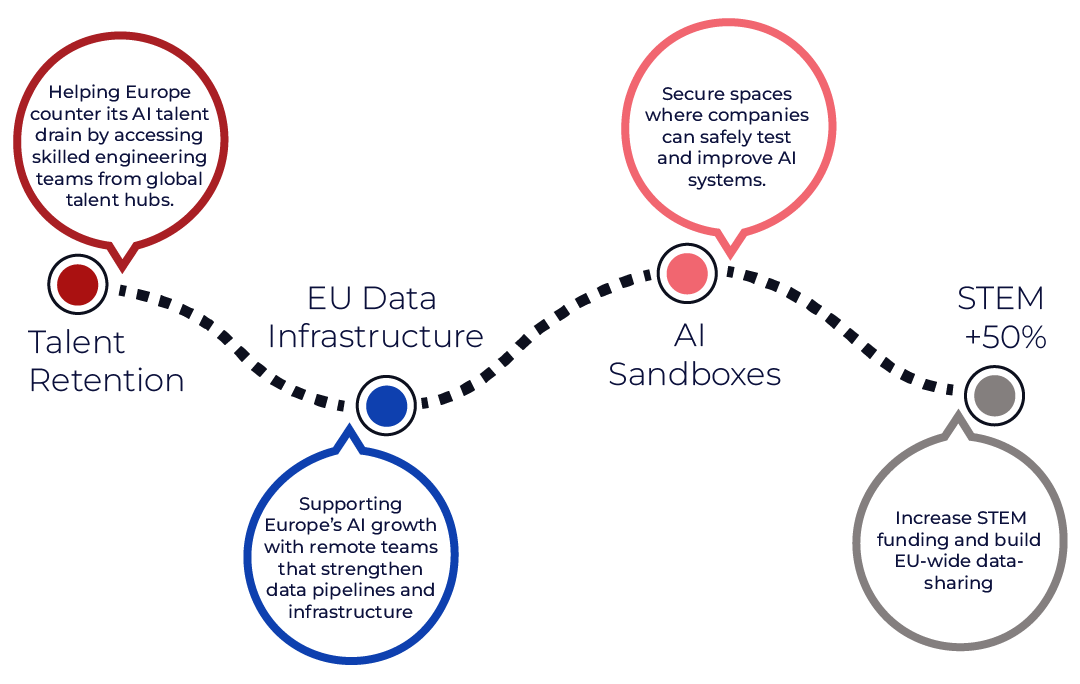
AI sandboxes for startups
Tax benefits for AI research and development
Streamlined compliance requirements for SMEs
Talent Initiatives
Minimum 50% increase in STEM funding
Stronger collaboration between industry and academia
More competitive compensation models in research
Market Accessibility
EU-wide data-sharing structures
Cross-border collaboration on AI initiatives
Easier access to public datasets
Final Thoughts: Time Is Running Out
Europe's delay in AI leadership is undeniable. Ethical frameworks matter, but regulation must not paralyze innovation. German companies — and European organizations as a whole — need to act now.
Long-term competitiveness depends on building AI capabilities and adopting AI-driven workflows sooner rather than later.
The Question Remains:
Will you wait for perfect regulatory conditions, or will you begin developing the AI expertise that will secure your organization's future today?
We use essential cookies and similar technologies to ensure the optimal operation of our website and to offer you a tailored user experience. Alongside these necessary cookies, we use additional cookies to enhance your experience, conduct analytics such as tracking visits and traffic sources, deliver relevant advertisements, and engage with third-party services.
By clicking "Accept", you consent to the use of all of these cookies on your device. You can adjust your cookie settings or withdraw consent at any time by selecting the "Customize Cookies" option.
You are under 16 years old? Then you cannot consent to optional services. Ask your parents or legal guardians to agree to these services with you.
Websites may store or retrieve information on your browser, mostly in the form of cookies. This information is used to personalize your experience and is not usually linked to your identity. You can choose not to allow certain types of cookies, but it may affect your website experience.
Choose Which Cookies To Enable
Strictly Necessary
Strictly necessary cookies enable website functionality and cannot be turned off. They are typically set in response to actions you take, like setting privacy preferences, logging in, or filling in forms. They do not store personal information.
Performance
Performance cookies track site visits and traffic sources to measure and improve site performance. They provide information on popular pages and visitor behavior. The information collected is anonymous. If you do not allow these cookies, we will not know when you have visited the site and cannot monitor its performance.
Targeting
Targeting cookies are cookies that our advertising partners may set on our site. They use them to create a profile of your interests and show relevant ads on other sites. They do not store personal information, but use your browser and internet device's unique ID. Without these cookies, you will see less targeted ads.